
REVIEW · CAMBODIA
Angkor wat and Small group temples Full day tours
Temples can feel overwhelming fast. This day tour makes Angkor manageable, and it’s built around small-group pacing plus a licensed English guide who brings the stories to life, with names like Marin and CHUM NAK standing out from past days. One watch-out: the tour price does not include Angkor Wat entrance, listed at $37 per person, and there’s no meal included.
I love the way the schedule moves you between major sites without you playing map Tetris all day. Marin, for example, was praised for letting people explore at their own speed, even when the group was slow, and for spotting strong photo angles.
My other practical note is simply this: it is a long day, about 9 hours, and you will be on your feet and in the sun. Comfortable shoes matter, and even though mineral water is included, you will still want to hydrate and take breaks when your guide suggests it.
In This Review
- Key things to know before you go
- A small-group Angkor day that stays human
- Pickup, comfort, and how the day actually flows
- Angkor Wat: start strong at the most famous temple
- Angkor Thom and Bayon: the city, the faces, the meaning
- Ta Prohm: when jungle and stone share the stage
- Terraces in Angkor Thom: the quick stops with real stories
- Terrace of the Elephants (about 30 minutes)
- Terrace of the Leper King (about 30 minutes)
- Baphuon Temple (about 30 minutes)
- Price and tickets: what $19 really gets you
- Choosing a guide: Marin and CHUM NAK are strong benchmarks
- Who this tour fits best
- Should you book this Angkor full-day small group tour?
- FAQ
- How long is the Angkor temples full-day small group tour?
- Do I get hotel pickup and drop-off?
- Is the tour guide English speaking?
- Are entrance fees included?
- Is lunch included?
- What group size should I expect?
- What is the cancellation policy?
Key things to know before you go
- Small group cap (up to 15) keeps the day from feeling like a cattle line
- English-speaking, licensed guide such as Marin or CHUM NAK gives clear Khmer context you can actually use
- Hotel pickup and drop-off in Siem Reap saves you time and hassle before the first temple
- A tight hit list covering Angkor Wat, Angkor Thom, Ta Prohm, Bayon, and the best terraces
- Entrance fees are separate and Angkor Wat is listed at $37 per person
- Air-con vehicle plus mineral water helps you handle the heat between stops
A small-group Angkor day that stays human
Angkor Archaeological Park is enormous, and first time visitors usually run into two problems. Either they see a lot but understand little, or they understand a lot but lose time to getting around. This tour solves the second problem by using an air-conditioned van or bus to move you between dispersed temples, so you are not spending your energy on logistics.
The small group size matters more than you might think. With a maximum of 15 travelers, you can actually ask questions, slow down when the details catch your eye, and take photos without feeling rushed. The best part is that you still cover major highlights like Angkor Wat and the heart of Angkor Thom, plus Ta Prohm with its famous roots.
Pickup, comfort, and how the day actually flows
You get hotel pickup and drop-off in Siem Reap, which I consider a big deal for Angkor days. When you start with a smooth departure, you arrive at the sites with less stress, and you are more likely to enjoy the first impressions instead of thinking about time.
The vehicle is air-conditioned, and mineral water is included. That helps on a day that includes early walking at large stone sites, often in bright sun. You also have multiple shorter stops, like 30-minute terrace visits, which means you can pace yourself. Even with a structured plan, a good guide can help you decide when to move fast and when to linger.
If you are the type who likes to read signs quietly, this day works well because you are not trapped in constant motion. If you like constant action, you will still feel plenty busy, but you can thank the guide for keeping the movement efficient.
Also on our Siem Reap list, if none of these land
- Siem Reap: Full-Day Angkor Wat Guided Tour with Sunset★ 4.9 · 3,803 reviews
- Full-Day Angkor Wat Sunrise Private Tour with Guide from Siem Reap★ 5.0 · 2,920 reviews
- Siem Reap: Angkor Wat Sunrise and Full-Day Sightseeing Tour★ 4.9 · 2,828 reviews
- Full-Day Guided Sunset Tour of Angkor Wat★ 5.0 · 1,507 reviews
Angkor Wat: start strong at the most famous temple
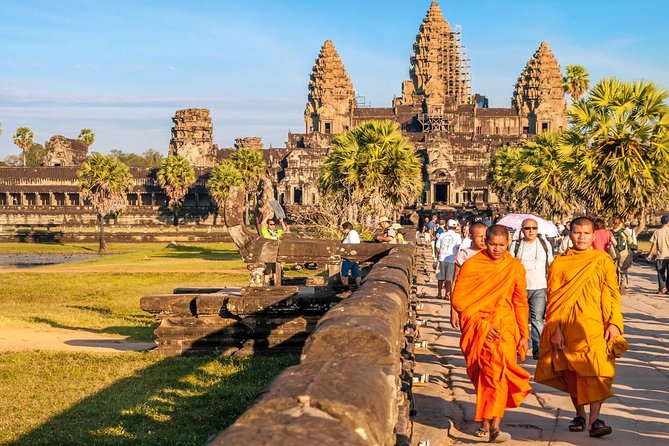
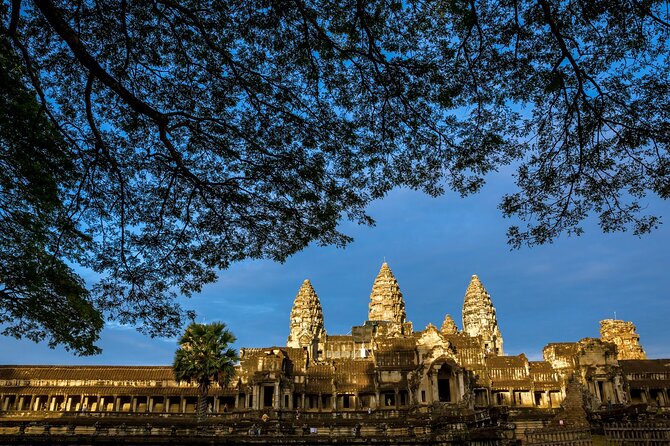
Angkor Wat is the headline stop for a reason. This vast Hindu-Buddhist complex sits within an ancient Khmer site measuring about 162.6 hectares, so it is not just one temple you wander past. It is a whole world of stone geometry, axis lines, and layered meaning.
Getting there first also helps you. Angkor Wat can be visually intense, and your brain needs a warm-up. When you start with Angkor Wat, you build a baseline for what you are seeing later in Angkor Thom, where the vibe turns more city-like and monumental.
You get around two hours here, and that is a sensible amount. Long enough to take in the main structure and walk enough to understand the layout, without turning the stop into an all-day grind. One practical drawback: the entrance fee is not included, and Angkor Wat is listed at $37 per person. So you should budget that into your real total, not just the $19 tour price.
My tip: treat the first 10 to 15 minutes like orientation time. Once your guide frames what you are looking at, the carvings and layout stop feeling like random stone and start feeling like a designed message.
Angkor Thom and Bayon: the city, the faces, the meaning
After Angkor Wat, the day shifts into Angkor Thom, the Great City built as the Khmer capital. This is where Angkor feels less like a single monument and more like a whole urban statement, with big temples that people come to see again and again.
You get another two-hour stop at Angkor Thom, which is a good balance. You have time to move through major highlights without feeling like you have to sprint. This is also where the guide’s explanation makes a real difference. A licensed guide can help you connect what you see to why it was built, and this is exactly what people loved about Marin and CHUM NAK.
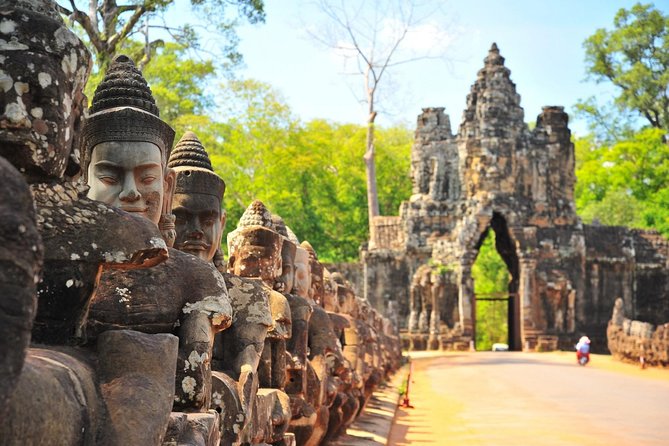
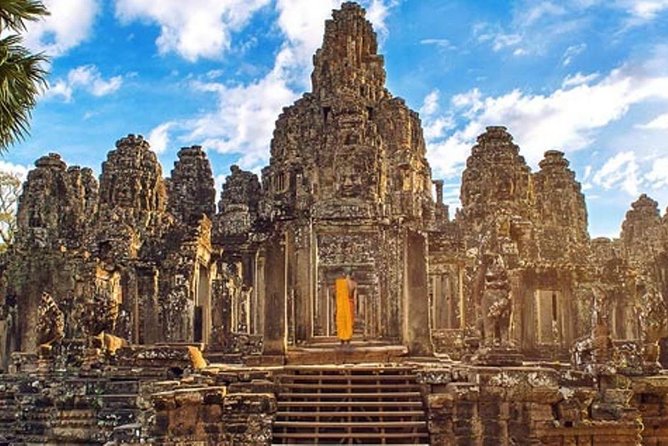
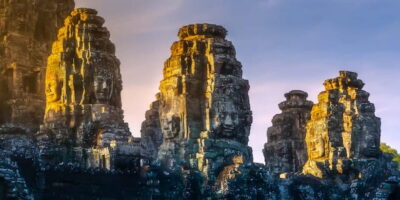
Bayon Temple is one of the core pieces inside Angkor Thom. It was the state temple of King Jayavarman VII, built at the end of the 12th century. It is also described as a mountain temple representing Mount Meru, the spiritual center concept in Khmer cosmology. That matters, because once you understand the idea of Mount Meru, those massive faces and layered structure feel intentional rather than just dramatic.
You spend about one hour at Bayon. That is enough time to walk through and take in the famous faces, but short enough that you still have energy for the terraces afterward.
Photo note: Bayon is all about angles and eye level. If you rush, you end up with the same postcard perspective. With a small group and a guide focused on photos, you have more chances to get better angles without constant crowd pushing.
Ta Prohm: when jungle and stone share the stage
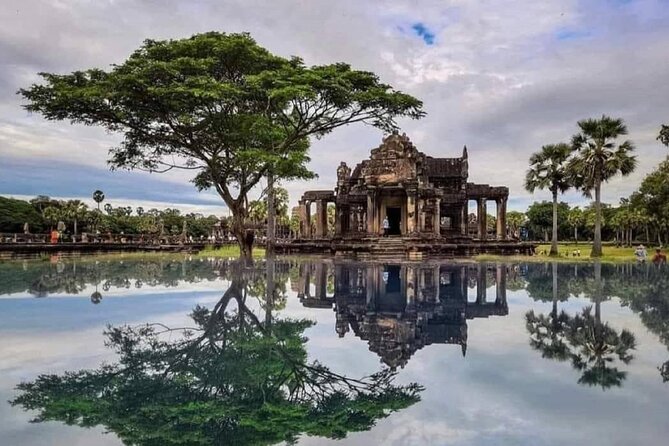
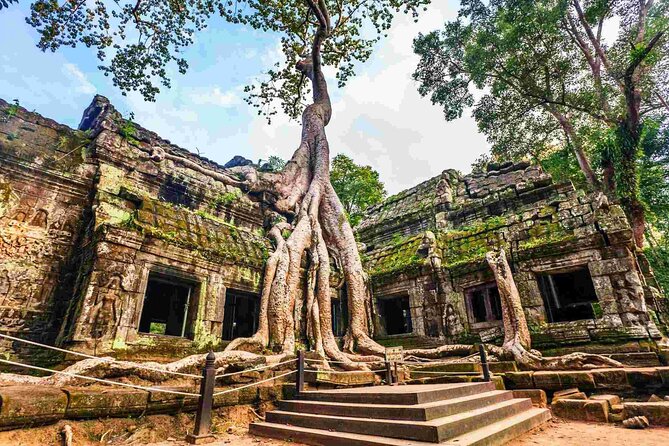
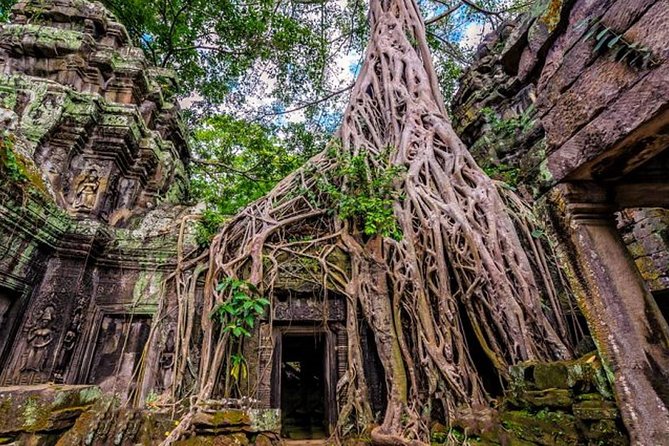
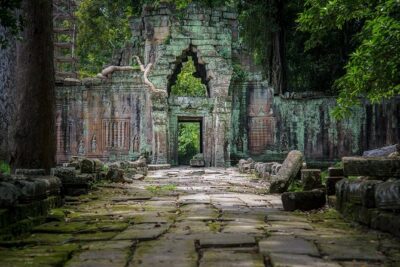
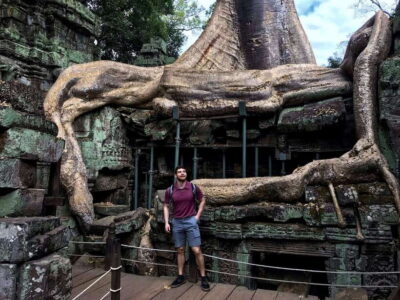
Ta Prohm is the stop many people picture before they ever arrive in Cambodia. The ruins mix with lush jungle, creating that cinematic look where trees seem to hold the architecture together. The effect is so strong because the place feels like time caught mid-sentence.
You get about one hour here. That is a comfortable amount of time for Ta Prohm because you will naturally slow down and look up, look around, and stare at the way roots wrap the stone. It is not just visual drama. It also helps you understand how Angkor sits in a living landscape, not a museum bubble.
The only downside to Ta Prohm time is that it can feel short if you love photography or enjoy taking your time with textures. But the tour’s small-group format can offset this, since you are not constantly being herded at full speed.
If you want a practical approach, pick one or two spots your guide recommends and then give yourself permission to wander nearby. The magic is in small details: mossy stone, root twists, and the way light falls through branches.
Terraces in Angkor Thom: the quick stops with real stories
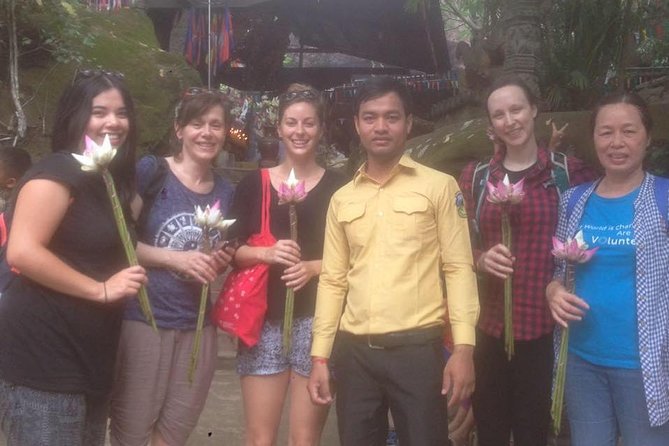
Once you move into the terraces, the tour becomes a smart mix of short stops and big impact. You can see a lot without burning out. Each terrace has its own function and personality.
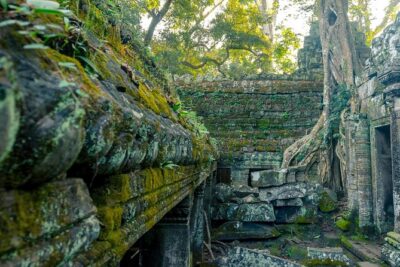

Terrace of the Elephants (about 30 minutes)
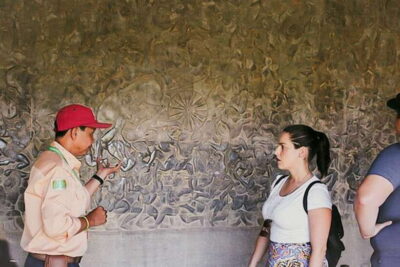
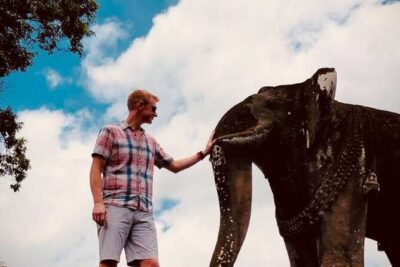
This is one of Angkor Park’s most visited spots. It was created as a viewing platform to welcome back victorious armies, which gives the stonework a job beyond scenery. When you stand there, you can almost picture ceremony and celebration.
You get 30 minutes, which sounds brief but fits the terrace style. Terraces are great for a focused walk and then a pause. If you use the time well, you get both the overview and the details.
Terrace of the Leper King (about 30 minutes)
Just north of the Terrace of the Elephants, this platform dates to the late 12th century. It is about 7 meters high, and it has figures standing on top (the defining feature is that statue group).
Because it is adjacent, it is easy to turn the two terraces into a single mental story. You start with victory and public viewing, then shift to the more mysterious, human-in-sculpture presence of the Leper King terrace.
Baphuon Temple (about 30 minutes)
Baphuon sits in Angkor Thom, northwest of Bayon. It was built in the mid-11th century and is described as a three-tiered temple. This stop is shorter, but it’s valuable because Baphuon helps you see how the architecture style keeps evolving across the city.
A 30-minute window can feel tight if you like long rests, but it works well if you treat it as a quick architecture check. Look up for tiers, then glance at the surrounding relationships to Bayon.
Price and tickets: what $19 really gets you
Here is the part I want you to understand clearly so you can budget without surprises.
The tour price is $19, and it includes an English-speaking licensed guide, air-conditioned transport, mineral water, and pickup and drop-off from your hotel in Siem Reap. That is solid value because you are paying for time, expertise, and logistics, not just a ride.
What is not included is the meal, and entrance fees are separate. Angkor Wat is specifically listed as $37 per person. So your realistic total cost is the tour price plus that entrance fee, and then whatever you choose for lunch.
If you are traveling on a tight budget, you can still make this work well. Pack a simple plan for food, and treat the entrance fee as part of the day’s baseline, not an optional add-on.
Also note a small but important detail: the tour uses a mobile ticket. That can make your day smoother if you prefer keeping everything on your phone instead of paper.
Choosing a guide: Marin and CHUM NAK are strong benchmarks
The tour’s biggest strength is the guide experience. People highlight how much the explanations changed the day, and two names show up with particular praise.
Marin was praised for being thoughtful, informative, and letting people explore at their own pace even when the group was slower. He was also noted for knowing photo spots and helping people get better pictures instead of just walking past.
CHUM NAK is described as a disrobed monk who studied history during that time. That kind of background tends to show up in how confidently and clearly the guide can connect symbols, architecture, and royal Khmer context. If you have a history brain, this is exactly the tour moment where that matters.
If you have any flexibility, ask about guide options when you book. Even if your guide is different, these examples tell you the bar the company aims for.
Who this tour fits best
This is a great choice if you are:
- Visiting Angkor for the first time and want an organized overview without spending hours figuring routes
- Someone who likes a plan, but still appreciates time to look and take photos
- Traveling with a group you want to keep small, ideally capped at 15 people
It may be less ideal if you want zero structure and endless roaming. This tour hits the big names and the key terraces with set time windows. You will see a lot, but you will not be doing a slow museum day where you chase every carving until sunset.
Should you book this Angkor full-day small group tour?
If you want a smart first trip to Angkor that balances major highlights with real explanations, I would book it. The value is in the combination of licensed English guide, hotel pickup, air-conditioned transport, and a route designed to cover the essentials without wasting your day moving between scattered sites.
My booking checklist is simple:
- Budget for Angkor Wat entrance at $37 per person
- Plan for lunch since meals are not included
- Wear good walking shoes and bring your own sun strategy
- If you care about history and photos, consider asking about guides like Marin or CHUM NAK
For many first-timers in Siem Reap, this is the kind of day that helps Angkor click. You leave with images, but also with a clearer sense of what you just saw and why it was built.
FAQ
How long is the Angkor temples full-day small group tour?
It runs for about 9 hours.
Do I get hotel pickup and drop-off?
Yes. Pickup and drop-off are included from your hotel stay in Siem Reap.
Is the tour guide English speaking?
Yes. An English-speaking licensed guide is included.
Are entrance fees included?
No. Entrance fees are not included. Angkor Wat entrance is listed as $37 per person.
Is lunch included?
No. Meal (Lunch/Dinner) is not included.
What group size should I expect?
The tour has a maximum of 15 travelers.
What is the cancellation policy?
You can cancel for a full refund up to 24 hours in advance of the experience start time.
More Full-Day in Siem Reap
- Siem Reap: Full-Day Angkor Wat Guided Tour with Sunset★ 4.9 · 3,803 reviews
- Full-Day Angkor Wat Sunrise Private Tour with Guide from Siem Reap★ 5.0 · 2,920 reviews
- Siem Reap: Angkor Wat Sunrise and Full-Day Sightseeing Tour★ 4.9 · 2,828 reviews
- Full-Day Guided Sunset Tour of Angkor Wat★ 5.0 · 1,507 reviews
More Tours in Siem Reap
- Angkor Wat Sunrise or Sunset Tour with Guide from Siem Reap★ 5.0 · 12,109 reviews
- Siem Reap: Angkor Wat: Small-Group Sunrise or Sunset Tour★ 5.0 · 9,444 reviews
- From Siem Reap: Kampong Phluk Floating Village Tour by Boat★ 4.9 · 6,979 reviews
- Siem Reap: Angkor Wat 2-Day Tour with Sunrise and Sunset★ 4.9 · 4,429 reviews
More Tour Reviews in Siem Reap
- Angkor Wat Sunrise or Sunset Tour with Guide from Siem Reap★ 5.0 · 12,109 reviews
- Siem Reap: Angkor Wat: Small-Group Sunrise or Sunset Tour★ 5.0 · 9,444 reviews
- From Siem Reap: Kampong Phluk Floating Village Tour by Boat★ 4.9 · 6,979 reviews
- Siem Reap: Angkor Wat 2-Day Tour with Sunrise and Sunset★ 4.9 · 4,429 reviews
Newly written up around Siem Reap
- Waterfall & River of 1000 Siva Linga- Kulen Mountain Private Tour
★ 5.0 · 3 reviews - Private Transfer from Siem Reap to Sihanoukville
★ 4.5 · 3 reviews - Private Tour to Koh Ker and Beng Mealea
★ 5.0 · 3 reviews - Private Transfer: Siem Reap Angkor Internation Airport to Hotel
★ 5.0 · 3 reviews - Kulen National Park Ticket -Waterfall & 1000 Lingas
★ 5.0 · 3 reviews - Kulen Waterfall & Kbal Spean Tour
★ 5.0 · 3 reviews
Full-Day, side by side.
 ★ 4.9Full-Day Angkor Wat Guided Tour with SunsetFrom $153,803 reviews
 ★ 5.0Full-Day Angkor Wat Sunrise Private Tour with Guide from Siem ReapFrom $602,920 reviews
 ★ 4.9Angkor Wat Sunrise and Full-Day Sightseeing TourFrom $142,828 reviews
 ★ 5.0Full-Day Guided Sunset Tour of Angkor WatFrom $191,507 reviews
 ★ 4.9Full Day Angkor Wat Temple Experience with SunsetFrom $251,490 reviews
 ★ 5.0Angkor Wat full Day ‘Small Group with sunset & Tour GuideFrom $141,369 reviews
 ★ 5.0Full-Day Banteay Srei & 4 Temples – Grand Tours Join-in TourFrom $201,155 reviews
 ★ 5.0Full-Day Temples of Angkor Small Group TourFrom $191,003 reviews