
REVIEW · CAMBODIA
Angkor Wat Private Tour in a Tuk Tuk
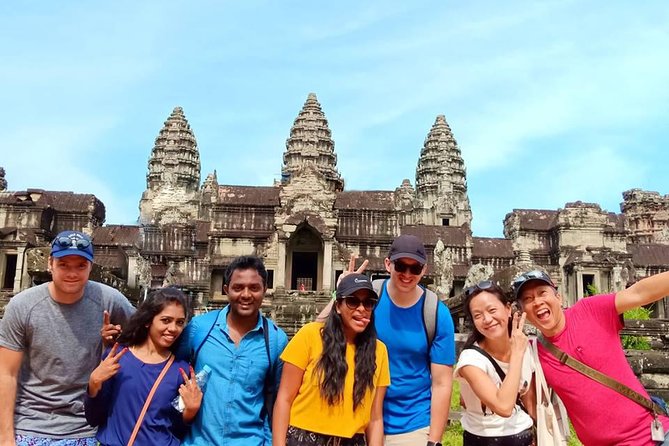
Tiny tuk-tuks mean big temples with less hassle. This is a private full-day Angkor Archaeological Park tour that uses a tuk-tuk to whisk you between key sights, while your local English guide explains Khmer history and the Hindu legends carved into temple walls. I love the hotel pickup and drop-off that keeps the day simple, and I also love how the guide helps you spot meaning in the carvings, not just look at stone. One consideration: the $45 price does not include the Angkor National Park admission, so you’ll need to budget that extra fee.
The route is built for comfort and flow. You’ll get bottled water, and the tuk-tuk helps you move through wide temple zones and tighter passageways without turning the day into a marching test. If you want a long, story-led day with minimal stress, it fits well, but it is still a long outing in Cambodia heat and sun.
In This Review
- Key highlights that make this tuk-tuk day work
- Why a private tuk-tuk plan beats a one-size bus ride
- Hotel pickup, water, and a guide who explains what you are seeing
- Price and tickets: what $45 really turns into
- 8:00 a.m. pickup in Siem Reap, then straight into the Angkor zone
- Angkor Thom: city-sized temples with storytelling in every direction
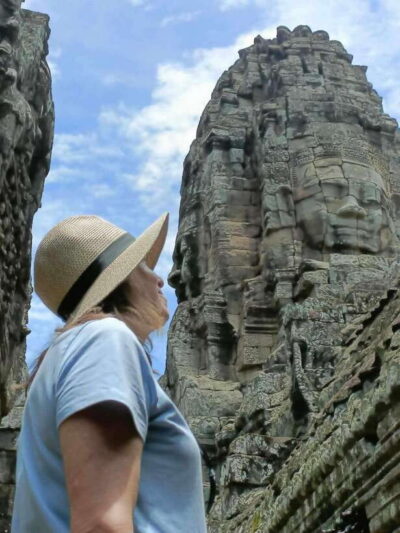
- Bayon Temple: where the carvings and faces hit hardest
- Terrace of the Elephants and the Leper King: victory and tragedy in stone
- Ta Prohm: ruin as beauty, with time to slow down
- Angkor Wat: the main event, with a full 2-hour block
- Tuk-tuk strategy: how to reduce walking without losing the sights
- Who should book this tour, and who should think twice
- Should you book this Angkor Wat private tuk-tuk tour?
- FAQ
- What time is pickup in Siem Reap?
- How long is the tour?
- Is the Angkor National Park admission fee included?
- Does the tour include hotel pickup and drop-off?
- Do I get water during the tour?
- Is this a private tour?
- What is the cancellation policy?
Key highlights that make this tuk-tuk day work
- Private group, your schedule, not a bus shuffle
- Hotel pickup and drop-off, plus bottled water for the ride
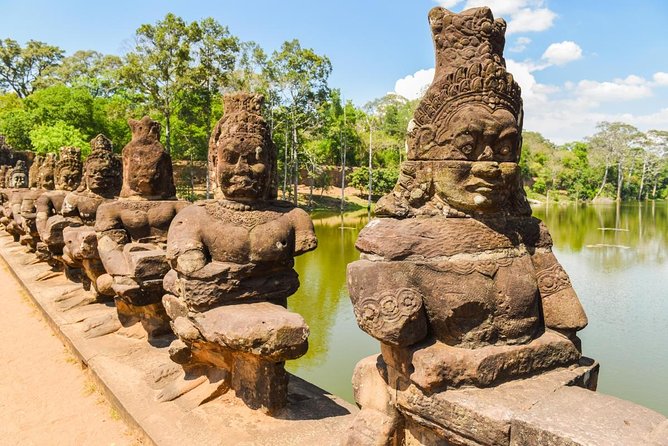
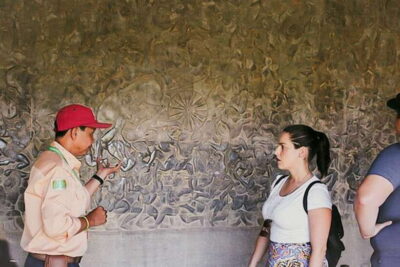
- Stop-to-stop commentary that connects Hindu legends to the carvings
- Smart temple mix, Angkor Thom, Bayon, terraces, Ta Prohm, and Angkor Wat
- Fewer steps, with the driver working to reduce walking where possible
Why a private tuk-tuk plan beats a one-size bus ride
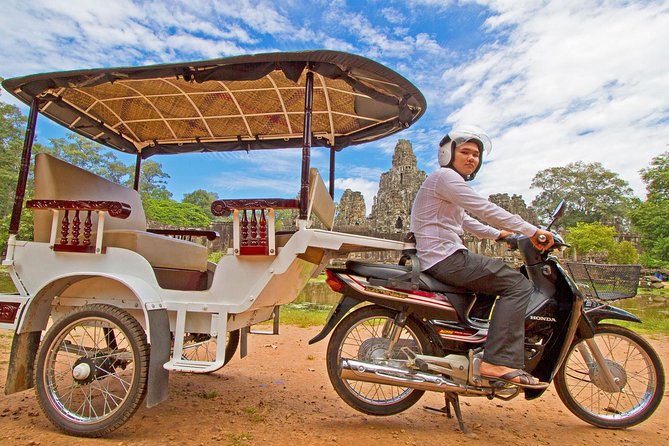
Angkor can feel like a dream and a maze at the same time. The temples are spread out, roads can be slow, and the site roads can twist more than you expect. A tuk-tuk solves a practical problem fast: you spend less time lost or waiting, and more time at the monuments where you actually want to be.
On this tour, the private setup matters. You are not squeezed into a large group pace. You can pause longer at a doorway full of carvings, or ask a question without worrying it will hold up a rowdy lineup. It also helps when you or someone in your group moves a bit slower. One highlighted experience involved an older passenger using a walking pole, and the guide and driver worked together to get them as close as they could to the monuments to cut down steps.
You also get a real advantage from the ride itself. Tuk-tuks let you slide through narrow stretches and between temple compounds in a way that feels less like transit and more like sightseeing in motion. That means you arrive ready to look, not already exhausted from getting there.
Hotel pickup, water, and a guide who explains what you are seeing
This is a guided tour, not a taxi with a map. You get local live English commentary, and that changes the whole experience. Angkor is famous, but what makes it satisfying is understanding why the art is there. When your guide talks through Khmer history and the Hindu legends shown in stone carvings, you start seeing patterns you’d otherwise miss.
Two small comforts make the day easier to enjoy. First, hotel or airport pickup and drop-off are included, so you do not have to figure out transport twice. Second, bottled water is provided during the tours. In Siem Reap and at the temples, hydration is not a theory, it is survival.
The reviews lean hard on guide quality. Names that came up include Soydy, Vantha, Phy, Long, Voath Vinh, Phuy Phy, and Nak, with people praising clear English and strong storytelling. I like this kind of guide because it does not turn into a lecture. It is more like having someone point out what to look for, and then letting you explore with better context in your head.
Other private bookings in Siem Reap
- Full-Day Angkor Wat Sunrise Private Tour with Guide from Siem Reap★ 5.0 · 2,920 reviews
- Siem Reap: Angkor Wat Private Tuk-Tuk Tour★ 4.9 · 2,222 reviews
- Angkor Wat Private Day Tour from Siem Reap★ 5.0 · 834 reviews
- Angkor Wat Private Tuk-Tuk Tour (sunrise Option) & more★ 5.0 · 439 reviews
Price and tickets: what $45 really turns into
The base price is $45.00 per person for the private tuk-tuk day (about 6 to 7 hours). That fee covers the tuk-tuk for the full day, the live English guide, pickup and drop-off, and bottled water.
The big add-on is the admission fee. The Angkor National Park Ticket Office fee is $37.00 per person, and it is not included. There is also a free admission note for a short Siem Reap stop at the start, but that does not replace the main temple ticket.
So the real budget to plan for is:
- Tour price: $45 per person
- Admission: $37 per person
- Total you should expect: $82 per person (not counting food and drinks)
Is it good value? For a private tuk-tuk day, yes, especially because you are paying for time, access, and interpretation. A lower-cost group tour might save money on paper, but you often trade away the guide attention and the ability to linger when something grabs your interest. If you care about history and carvings and you hate wasting time in transit, this is a strong match.
8:00 a.m. pickup in Siem Reap, then straight into the Angkor zone
The day starts with an 8:00 a.m. pickup from your hotel in Siem Reap. From there, you begin the temple route by tuk-tuk. There is a brief Siem Reap stop at the start, and it’s marked as a short stop with no admission required.
This early start matters because it gives you more usable daylight for temples and photos, and it helps you settle into the rhythm before the site feels crowded. It also reduces the chance that you spend the middle of your day hunting for water or shade.
Keep an eye on pace. The tour uses time blocks at each stop, but the real speed comes from how much you want to read the carvings and how often you want to pause. If you like a steady crawl, you’ll be happy. If you want a fast photo sweep only, you might feel the day is packed, because the stops are built to include real commentary and time inside the compounds.
Angkor Thom: city-sized temples with storytelling in every direction
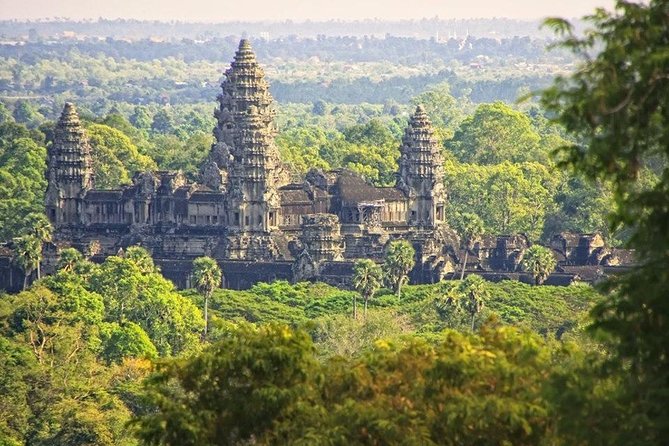
Angkor Thom is the first true “wow” moment after you head out. This was the capital city of the Khmer empire, built at the end of the 12th century, tied to King Jayavarman VII. It sits north of Angkor Wat, between the West Baray and East Baray, so it sets your mental map for the whole complex.
You get about 40 minutes at this stop. The time is enough to get oriented, walk key areas, and let your guide point out why certain layouts matter. Even if you only do a partial route inside Angkor Thom, the perspective is useful: you start to understand the planning behind the stone, not just the stones themselves.
What I like about leading with Angkor Thom is that it turns Angkor from one famous temple into a whole royal and spiritual setting. You’ll be less likely to think of the day as a checklist, and more likely to see how each site connects.
A possible drawback: if you are extremely heat-sensitive or only want the single biggest monument, Angkor Thom can feel like a lot before you reach Angkor Wat. But the payoff is that your later stops hit harder, because you understand the story thread your guide is building.
Bayon Temple: where the carvings and faces hit hardest
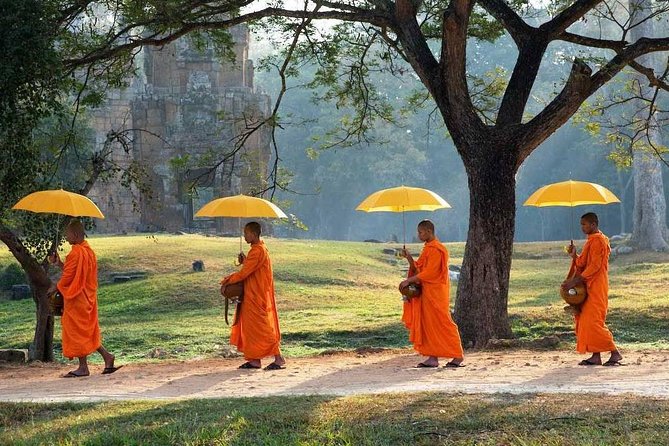
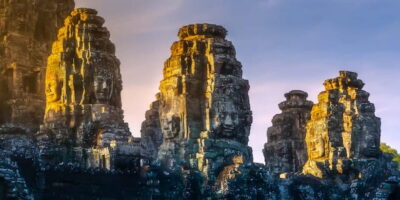
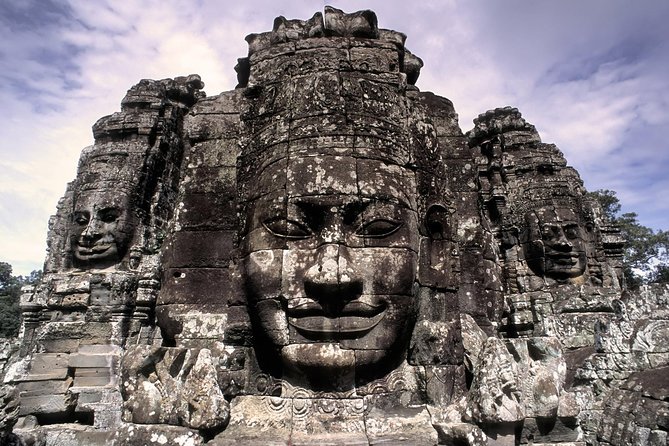
After Angkor Thom, the tour heads to Bayon Temple, the richly decorated Khmer temple at the center of Angkor. Bayon is tied to the late 12th or early 13th century, built as the state temple for the Mahayana Buddhist King Jayavarman VII.
You get around 40 minutes here. Bayon is one of those places where you can look for hours and still find new details. The guide commentary helps you make sense of the temple’s design and the religious symbolism in the carvings. Instead of just thinking, That’s cool, you start thinking, This is a message.
This is one of the stops where a guide with strong English pays off the most. People love the temple for its faces, but the deeper value is knowing what those details represent and why certain motifs show up where they do.
If you want to move quickly through the main viewpoints, you can. If you enjoy reading stone details, this is where you’ll naturally slow down and spend more time than you planned, because it is hard to rush something so covered.

Terrace of the Elephants and the Leper King: victory and tragedy in stone
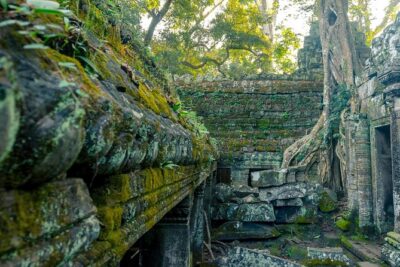
Next up is the Terrace of the Elephants, with an additional stop for the Terrace of the Leper King. The Terrace of the Elephants is described as a platform where the king viewed the victorious return of his army. It’s a perfect example of how temple spaces were used as stages for power and memory, not only worship.
You get about 30 minutes for these terraces. That’s enough time to walk the edges, look across the platform, and focus on the carving scenes. Your guide’s storytelling helps you connect the scenes to the kind of messages rulers wanted people to remember.
Then you move to the Terrace of the Leper King, known for detailed carvings. This is one of the areas that can surprise you. From a distance it is just another carved stone terrace, but up close the details reward attention.
Practical note: terraces are open and exposed. Plan for sun. Stay hydrated, use your water bottle, and take breaks when you need them. The tuk-tuk ride can be comfortable, but these stops are still “walk and look” in open air.
Ta Prohm: ruin as beauty, with time to slow down
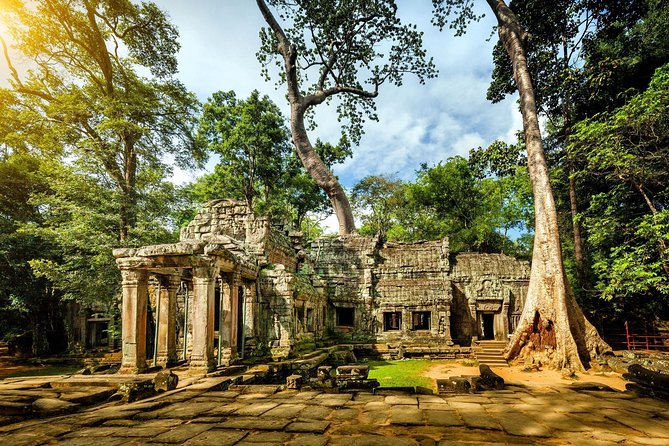
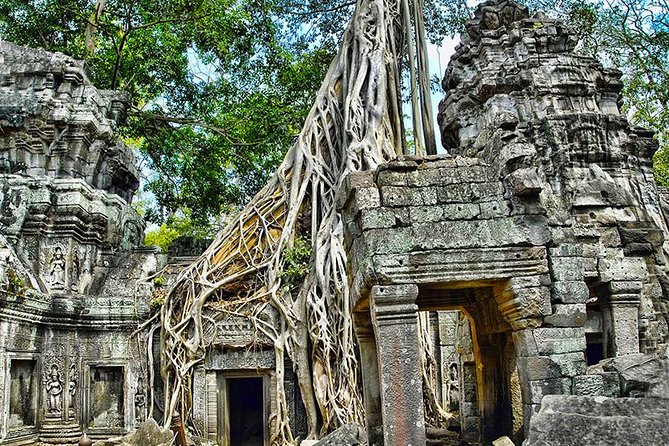
After the terraces, the tour goes to Ta Prohm Temple. This is the temple many people picture when they think of Angkor’s famous ruins. Ta Prohm is described as a state of ruin that is also a state of beauty. It was built around the mid-12th century into the early 13th century, linked to Jayavarman VII.
You get about 1 hour at Ta Prohm. That time is important. Ta Prohm is not a quick stop if you actually want to enjoy it. The trees, broken stone lines, and shadowy corridors are visually busy, and it’s easy to feel like you are just photographing without really looking. A guide’s explanations help you see what you are looking at, which makes the ruin feel less random.
I also like the hour because you can choose your rhythm. If you want a slower walk and calmer viewing, you can drift. If you want a structured route to major viewpoints, you can keep moving without feeling like you missed half the temple.
Admission is not included for this stop, just like the other temples. You will already have your park ticket sorted by now, so it’s a smooth transition once you’re inside.
Angkor Wat: the main event, with a full 2-hour block
Finally, the tour reaches Angkor Wat, one of the most famous temple complexes in the world. Angkor Wat was built in the early 12th century for King Suryavarman II, and it served as his state temple and capital city. It is also noted as the best-preserved temple at the site.
You get about 2 hours at Angkor Wat. That is a smart amount of time. Angkor Wat is big enough that two hours lets you see major parts without turning the last part of your day into a sprint. It also gives you time to regroup if you got slowed down earlier, or to go back to a detail you noticed at Bayon.
This stop is where the day’s commentary clicks into place. If your guide has been connecting Hindu legend and Khmer history through the carvings all morning and early afternoon, Angkor Wat feels like the payoff. Even if you only catch part of the explanations, your eyes will be trained to notice symbolism and repeating motifs.
One more practical point: Angkor Wat is the most “must-see” place on the route, so it’s worth conserving energy. Use your water, take short shade breaks when you can, and pace yourself. Your legs might be fine, but your attention can fade if you treat it like a race.
Tuk-tuk strategy: how to reduce walking without losing the sights
The tour’s selling point is transport by tuk-tuk, and it genuinely helps. The Angkor Archaeological Park is vast, and you will cover more ground than you think. Tuk-tuk travel reduces the friction of moving between temple zones, and it can get you close to monuments along the way.
That said, you should still expect some walking. Even with the tuk-tuk advantage, you will move on foot through temples, courtyards, and terraces. What I’d do is plan your comfort:
- Wear breathable shoes with decent grip.
- Use a hat or light sun protection.
- Keep water in reach, since you have bottled water provided but you’ll still want to drink often.
Mobility can be a key issue at Angkor. One of the strongest review examples involved a passenger at age 82 using a walking pole, and the driver and guide worked to take them as close as possible to monuments to reduce walking. If you have mobility concerns, this is exactly the kind of tour style that can help. Still, you should expect uneven stone and steps in places.
Also, bring patience. Tuk-tuks are convenient, but the site is not a parking lot. You will still wait at certain areas, and your guide will steer you where you need to be based on your route and time.
Who should book this tour, and who should think twice
Book it if you:
- Want private transport so you can keep your own pace
- Like explanations that connect carvings to Hindu legends and Khmer history
- Prefer a guided day over an independent slog
- Value hotel pickup and drop-off to simplify your logistics
This tour might be less ideal if you:
- Only care about the single biggest temple and dislike time spent at multiple stops
- Want a very short day, because this is designed for a full morning through afternoon experience
It also fits well for mixed groups. Families can enjoy the variety of temple types. History lovers get real context in each compound. And for older visitors or anyone who benefits from reduced walking, the tuk-tuk and the guide-driver teamwork can make a meaningful difference.
Given the consistent 5-star rating and strong recommendation rate, it’s clear the basics work: guide quality, pacing, and the value of private transport.
Should you book this Angkor Wat private tuk-tuk tour?
I’d book it if you want the “best of Angkor” feel without turning your day into an endurance event. The combination of private tuk-tuk logistics, hotel pickup/drop-off, bottled water, and stop-by-stop commentary is a practical way to see the big temples and still understand what you are looking at.
But do your budget math first. With the Angkor National Park admission fee added on top, your true per-person cost is higher than the headline price. If you are comfortable with that, you are paying for a guided, streamlined, private day that saves energy and adds meaning to the stone.
If you want Angkor as a story, not just as scenery, this tour style makes a lot of sense.
FAQ
What time is pickup in Siem Reap?
Pickup is scheduled for 8:00 a.m. from your hotel in Siem Reap.
How long is the tour?
The tour runs about 6 to 7 hours.
Is the Angkor National Park admission fee included?
No. The Angkor National Park Ticket Office fee is listed as $37.00 per person.
Does the tour include hotel pickup and drop-off?
Yes. Hotel pickup and drop-off are included, and airport pickup and drop-off are also listed as included.
Do I get water during the tour?
Yes. Bottled mineral water is provided during the tour.
Is this a private tour?
Yes. It is described as private, meaning only your group participates.
What is the cancellation policy?
You can cancel up to 24 hours in advance for a full refund. If you cancel less than 24 hours before the start time, the amount paid is not refunded.
Other Bookings Kept Private
- Full-Day Angkor Wat Sunrise Private Tour with Guide from Siem Reap★ 5.0 · 2,920 reviews
- Siem Reap: Angkor Wat Private Tuk-Tuk Tour★ 4.9 · 2,222 reviews
- Angkor Wat Private Day Tour from Siem Reap★ 5.0 · 834 reviews
- Angkor Wat Private Tuk-Tuk Tour (sunrise Option) & more★ 5.0 · 439 reviews
More Tours in Siem Reap
- Angkor Wat Sunrise or Sunset Tour with Guide from Siem Reap★ 5.0 · 12,109 reviews
- Siem Reap: Angkor Wat: Small-Group Sunrise or Sunset Tour★ 5.0 · 9,444 reviews
- From Siem Reap: Kampong Phluk Floating Village Tour by Boat★ 4.9 · 6,979 reviews
- Siem Reap: Angkor Wat 2-Day Tour with Sunrise and Sunset★ 4.9 · 4,429 reviews
More Tour Reviews in Siem Reap
- Angkor Wat Sunrise or Sunset Tour with Guide from Siem Reap★ 5.0 · 12,109 reviews
- Siem Reap: Angkor Wat: Small-Group Sunrise or Sunset Tour★ 5.0 · 9,444 reviews
- From Siem Reap: Kampong Phluk Floating Village Tour by Boat★ 4.9 · 6,979 reviews
- Siem Reap: Angkor Wat 2-Day Tour with Sunrise and Sunset★ 4.9 · 4,429 reviews
Newly written up around Siem Reap
- Waterfall & River of 1000 Siva Linga- Kulen Mountain Private Tour
★ 5.0 · 3 reviews - Private Transfer from Siem Reap to Sihanoukville
★ 4.5 · 3 reviews - Private Tour to Koh Ker and Beng Mealea
★ 5.0 · 3 reviews - Private Transfer: Siem Reap Angkor Internation Airport to Hotel
★ 5.0 · 3 reviews - Kulen National Park Ticket -Waterfall & 1000 Lingas
★ 5.0 · 3 reviews - Kulen Waterfall & Kbal Spean Tour
★ 5.0 · 3 reviews
Tuk-Tuks, side by side.
 ★ 4.9Angkor Wat Private Tuk-Tuk TourFrom $202,222 reviews
 ★ 4.9Tuk-Tuk, Bamboo Train, Killing/Bat Caves, SunsetFrom $91,436 reviews
 ★ 5.0Siem Reap Countryside Bike Tour / E-Bike or Tuk TukFrom $35935 reviews
 ★ 5.0Battambang Tuk Tuk tour: Bambootrain, Killing & Bat Caves,SunsetFrom $15799 reviews
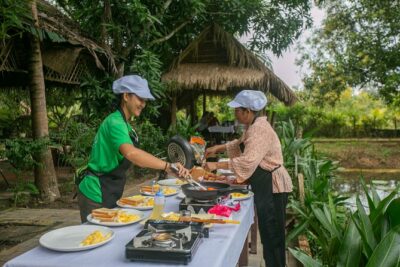 ★ 5.0Angkor Sunrise Bike Tour / E-Bike or Tuk TukFrom $60615 reviews
 ★ 5.0Phnom Penh Silk Island Bike Tour/ E-Bike or Tuk TukFrom $35495 reviews
 ★ 5.0Angkor Wat Private Tuk-Tuk Tour (sunrise Option) & moreFrom $25439 reviews
 ★ 5.0Ultimate Phnom Penh Food Tour by Tuk Tuk: 20 Tastings and DrinksFrom $69409 reviews
Also appears in