
REVIEW · ANGKOR
Siem Reap 2-Day Private Angkor Wat Tour with Sunrise
Sunrise at Angkor Wat hits fast. This private two-day Angkor experience strings together Angkor Wat at sunrise and Phnom Bakheng at sunset, with English guidance and time to linger where you want. You also get a smart mix of big-name icons and quieter temple stops.
I especially like the pacing you control with a personal guide, so you can slow down for carvings or hustle to catch the best light. I also love the small comfort touches, cold water and towels keep you from feeling totally cooked between temples, which matters in Siem Reap heat and humidity.
One consideration is the cost stack: the $135 tour price does not include the Angkor Archaeological Park entrance ticket (USD 62 per person for 2-3 days). Also, you have an early start for sunrise, and temple dress rules can be strict, so plan clothing ahead.
In This Review
- Key highlights worth planning for
- Value and pricing: $135 is the guide, rides, and site time
- Transport that fits your group, plus comfort when it matters
- Before you go: the temple ticket, and when you buy it
- Day 1 starts with Angkor Thom’s South Gate, then the Bayon faces
- Baphuon and the Terrace stops: big stone, ceremonial meaning
- Ta Prohm’s roots: the stop for people who like mood and photos
- Lunch at Srah Srang: a break that keeps you on schedule
- Angkor Wat after lunch: world-famous monument, carvings you can actually read
- Day 1 sunset at Phnom Bakheng: golden hour from a temple viewpoint
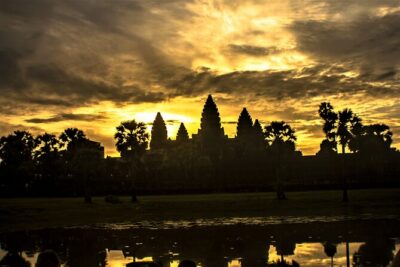
- Day 2 starts at 5:00 AM: sunrise at Angkor Wat without the scramble
- Pre Rup after breakfast: mountain-style views with a calmer feel
- Banteay Srei’s pink sandstone carving detail
- Banteay Samre and Ta Som: quieter temple mood, tree roots again
- Neak Pean: a small island temple with healing-lake symbolism
- Preah Khan: larger complex with atmospheric corridors and mixed influences
- Guides and drivers: English explanations plus steady, friendly handling
- Dress code: plan for covered shoulders and knees, not last-minute fixes
- Who should book this Angkor Wat sunrise plus sunset tour
- Should you book this tour?
- FAQ
- Is the Angkor Archaeological Park entrance ticket included in the tour price?
- What is the starting time for the Day 1 pickup?
- What is the pickup time for the Day 2 sunrise?
- Are lunch and drinks included?
- What transport will I use on each day?
- Does the tour include a guide, and what language do they speak?
- What is included during the tour for comfort?
- Do I need an entrance ticket for children under 12?
- What is the dress code for the temples?
- Can I cancel and get a full refund?
Key highlights worth planning for
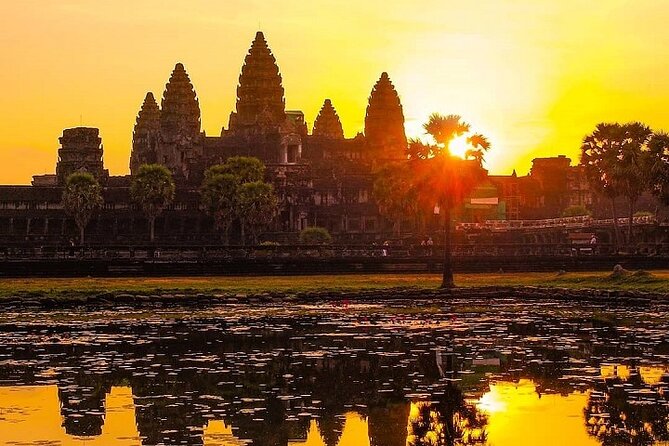
- Angkor Wat sunrise and Phnom Bakheng sunset in the same two-day plan
- English-speaking guide who can explain what you are seeing, not just move you along
- Real temple variety from Angkor Thom gates and Bayon faces to Ta Prohm roots
- Comfort breaks built in with cold water and towels during the day
- Second-day temples after breakfast that feel calmer than the big crowds
Value and pricing: $135 is the guide, rides, and site time
At $135 per person, you are paying for the core experience: an English-speaking guide, hotel pickup and drop-off in Siem Reap city, and transportation that matches your group size. You are also getting a private setup, meaning it is just your group moving through the Angkor Archaeological Park.
Here is the part that makes the value feel real, not just marketing: you are not just collecting temple photos. The day structure is built around two different lighting moments, sunrise at Angkor Wat and sunset from Phnom Bakheng, plus a full day of temples at a pace you can adjust. That is the difference between a fast checklist and a trip that feels worth the early wake-up.
What is not included is important for budgeting. The Angkor Archaeological Park entrance ticket is separate, and lunch is not listed as included. So think of $135 as your guide and logistics cost, and add the entrance ticket on top.
Transport that fits your group, plus comfort when it matters
How you ride depends on your group size:
- For 1 to 2 people, Day 1 uses a tuk-tuk, and Day 2 uses a private car.
- For groups of 3 or more, you travel both days by A/C van or bus.
Why this matters: Angkor days involve a lot of short hops and waiting while your group lines up, climbs stairs, or just catches a view. Having A/C for the longer transfers (if you are in a bigger group) is a big quality-of-life upgrade. Even on smaller groups, cold water and towels are included, which is a practical win for staying functional between sites.
Also, you will get hotel pickup and drop-off in Siem Reap city. That removes one of the most annoying parts of visiting Angkor: figuring out who pays for what and when.
Other ways to be at the temples before the light comes up
- Angkor Wat Sunrise or Sunset Tour with Guide from Siem Reap★ 5.0 · 12,109 reviews
- Siem Reap: Angkor Wat: Small-Group Sunrise or Sunset Tour★ 5.0 · 9,444 reviews
- Siem Reap: Angkor Wat 2-Day Tour with Sunrise and Sunset★ 4.9 · 4,429 reviews
- Angkor Wat Sunrise tour with Small – Group and Guide tours★ 5.0 · 3,655 reviews
Before you go: the temple ticket, and when you buy it
The Angkor Archaeological Park entrance ticket is not included in the tour price. You need to purchase it separately, and it is listed at USD 62 per person for 2-3 days.
On Day 1, your guide meets you at 8:30 AM at your hotel lobby, and then you head to the ticket booth to purchase the temple pass. If you prefer, you can buy it online beforehand. Either way, build in a little extra time for ticket handling.
One family detail worth knowing: children under 12 can join free of charge, but you must show a passport as proof. Adults aged 12 to 90 pay the standard entrance price.
Day 1 starts with Angkor Thom’s South Gate, then the Bayon faces
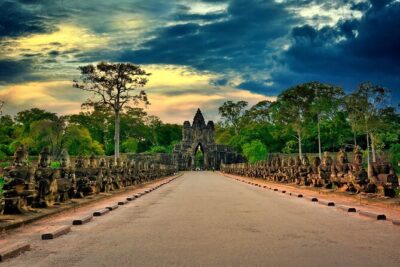
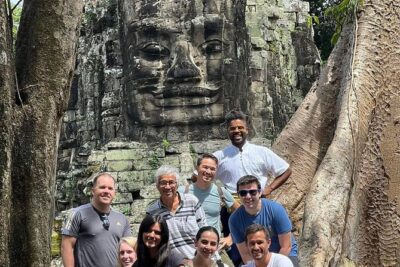
Day 1 has a classic Angkor Thom loop, starting at the South Gate with those giant smiling faces that form the grand entrance into the city. This is a strong first stop because it gives you immediate context: this is not just one temple, it is a whole world of stone city gates and sculpted storytelling.
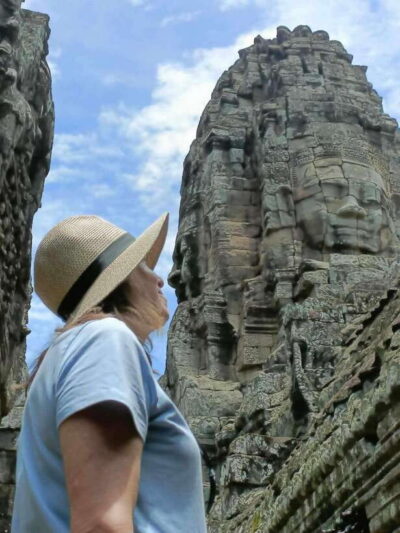
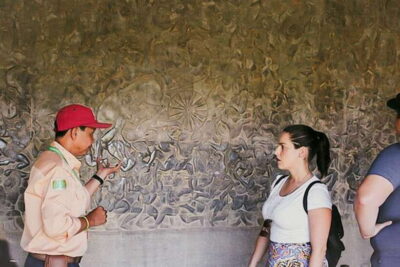
From there, you move to Bayon Temple, known for towers carved with more than 200 serene smiling faces. If you like details, Bayon is where you can get lost in bas-reliefs showing ancient Khmer life. The upside is that it feels like you are reading a visual record. The downside is practical, you will likely be standing still for a while and then squeezing into view points, so wear shoes you can do a lot of walking in.
Baphuon and the Terrace stops: big stone, ceremonial meaning
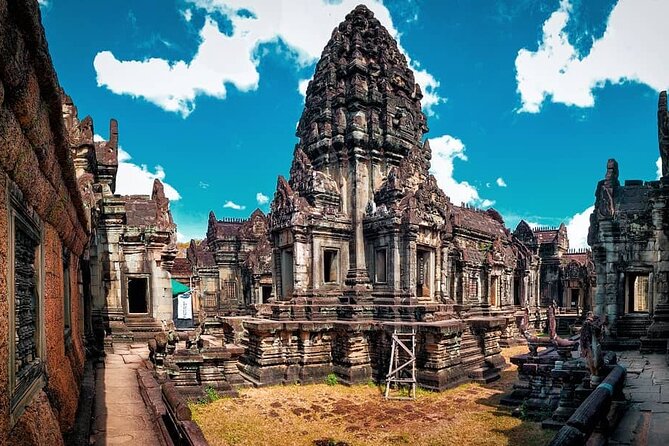
Next is Baphuon Temple, described as a massive three-tiered pyramid temple originally dedicated to Shiva. You will see steep terraces and intricate bas-reliefs, and it was once the tallest structure in the city. This stop works well for two reasons: the scale is obvious even without a long explanation, and the tiered layout naturally gives you multiple angles to observe carvings.
Then you visit the Terrace of the Elephants, a long ceremonial platform in Angkor Thom famous for carved elephant and garuda figures. The key value here is purpose. It was used by Khmer kings to view parades and public events, so you are not just looking at art, you are imagining a civic stage.
After that, you reach the Terrace of the Leper King, a raised platform decorated with intricate bas-reliefs. It gets its name from a mysterious statue that was once thought to depict a leper king. This is one of those stops where the wording alone signals something unusual and a bit uncertain, which makes it interesting when your guide connects the story to what you can actually see in front of you.
Ta Prohm’s roots: the stop for people who like mood and photos
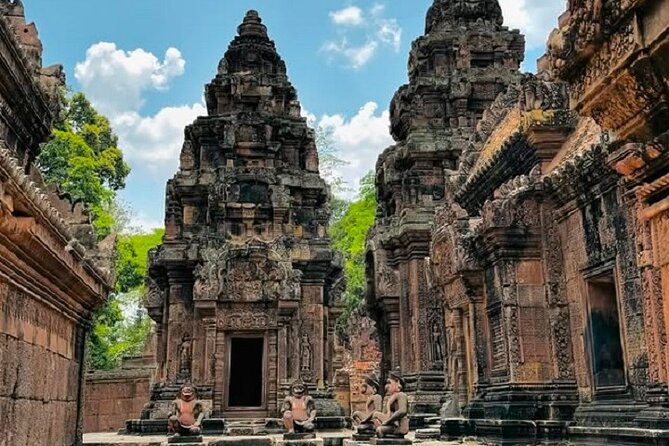
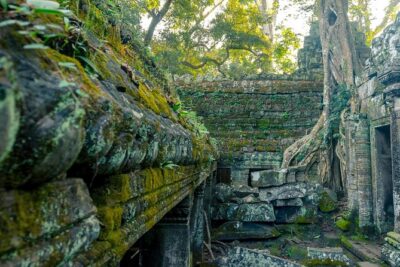
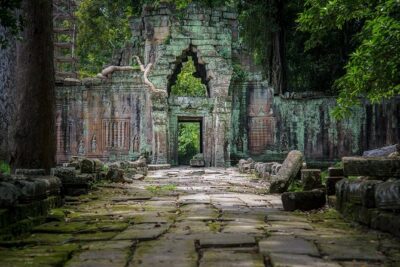
Ta Prohm is the temple stop that most people recognize, even if they did not come here for Cambodia only. It is famous for massive tree roots growing over the ruins, giving it that dramatic lost-in-the-jungle feeling. It is also noted for its pop-culture connection, featured in Tomb Raider.
The practical benefit of including Ta Prohm on Day 1 is timing. When you arrive earlier in the day, you can spend time on the edges of the “ruins and trees” compositions without feeling rushed. The trade-off is that it can still be crowded and photos can be slow. If you are sensitive to waiting, use your guide to help you pick viewing spots and move with intention.
Other private bookings in Siem Reap
Lunch at Srah Srang: a break that keeps you on schedule
Midday, you take lunch at a nearby restaurant recommended by your guide at Srah Srang. Lunch is not included, so treat this as your chance to refuel and cool down.
Why this works: the temple circuit is heavy, and a built-in meal break helps you keep energy for the afternoon. If you have dietary needs, it is smart to plan what you can eat before you order, since the exact restaurant choice is not described in advance.
Angkor Wat after lunch: world-famous monument, carvings you can actually read
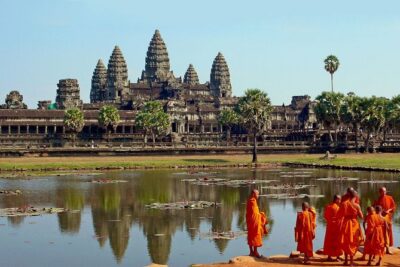
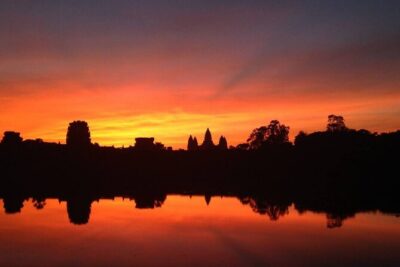
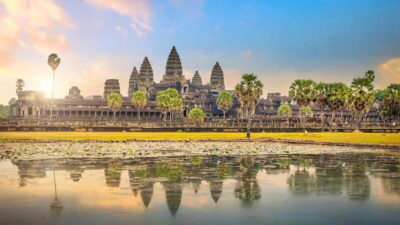
After lunch, you visit Angkor Wat, described as the world’s largest religious monument with stunning architecture and intricate carvings. The best part of this timing is that you are not just going to Angkor Wat because it is famous. You are going after a full morning of Angkor Thom context, so the styles and themes can feel more connected.
In practical terms, you will get time to explore and take it in rather than racing straight to a single landmark point. The downside is the same one you face across Angkor, you are walking and climbing in warm weather. The included water and towels help, but it still helps to pace yourself.
Day 1 sunset at Phnom Bakheng: golden hour from a temple viewpoint
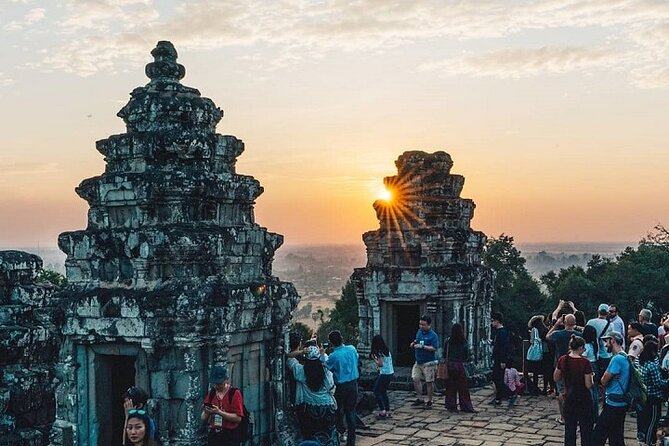
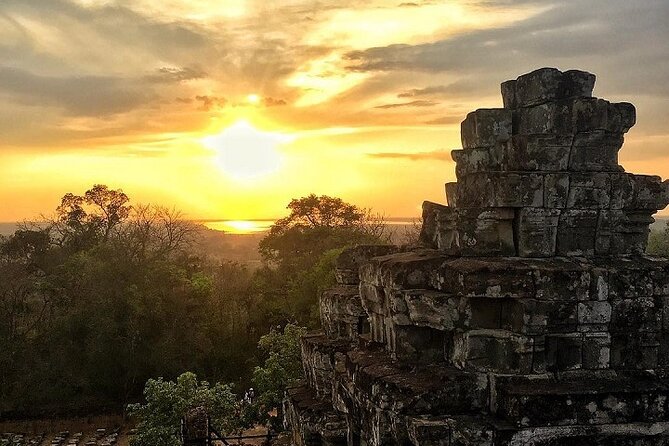
Your Day 1 ends at Phnom Bakheng for sunset. The description is straightforward: enjoy a stunning sunset view over the Angkor temples and surrounding countryside.
This stop is valuable because it gives you a different angle than Angkor Wat. You are stepping away from the main shrine mood and looking outward, which changes how the site feels. If you are chasing photos, build time for slow looking. The payoff is in watching light move across stone.
Day 2 starts at 5:00 AM: sunrise at Angkor Wat without the scramble
On Day 2, you get a very early pickup, 5:00 AM from your hotel, to catch sunrise at Angkor Wat. You are advised to bring breakfast from your hotel to enjoy after the sunrise, which is a smart practical touch. You will not be hungry for the first viewing moment because you have time to eat afterward.
This is the kind of start that splits people into two camps. If you like early mornings, it feels magical. If you hate waking up before the sun, it will be tough. Either way, having a guide handle the timing and entry makes the early portion far less stressful.
Pre Rup after breakfast: mountain-style views with a calmer feel
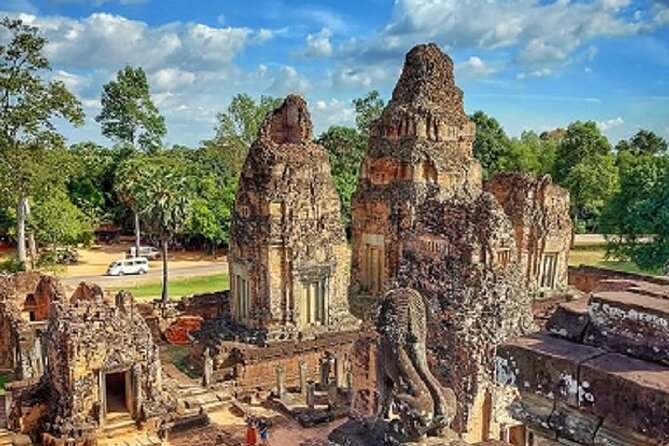
After sunrise, you eat breakfast at the temple, then visit Pre Rup, described as a mountain-style temple with stunning views over the surrounding countryside and a peaceful early morning atmosphere.
The reason Pre Rup often clicks for people is that it is positioned after sunrise, when energy is still high but you might feel more grounded than you would mid-day. The view value is stated clearly in the description, and the calm is part of why it is scheduled here.
Banteay Srei’s pink sandstone carving detail
Next comes Banteay Srei, called the Citadel of Women. It is famed for intricate pink sandstone carvings and exquisite bas-reliefs, and it is described as among the finest artistry in Angkor.
This is the stop for detail lovers. When the stones are pink and the carvings are dense, you can spend real time studying patterns instead of just admiring a large structure. The trade-off is that you need patience. If you only want broad views and quick photo angles, you might not enjoy spending longer with fine artwork.
Banteay Samre and Ta Som: quieter temple mood, tree roots again
After Banteay Srei, you visit Banteay Samre, a serene 12th-century temple known for detailed carvings and symmetrical design, with a peaceful atmosphere and a quieter experience away from the main crowds.
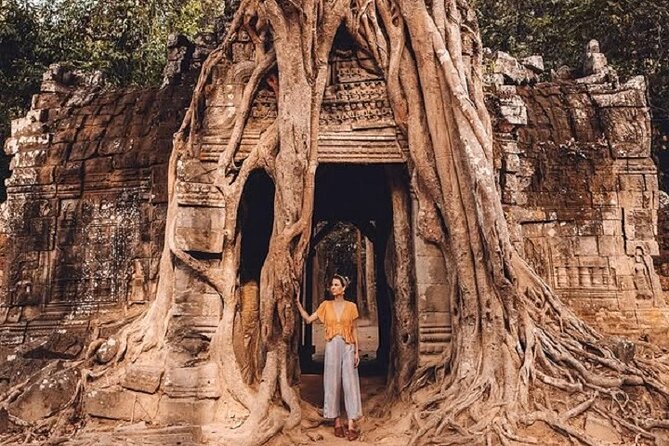
Then Ta Som arrives for a second round of tree-root drama, described as a small 12th-century temple famous for giant tree roots growing over its eastern gate, creating that temple reclaimed by the jungle look.
These two stops balance each other. Banteay Samre gives you calm structure and symmetry. Ta Som gives you the chaotic nature taking over. The pacing helps too, you are not only repeating one type of scene back to back.
Neak Pean: a small island temple with healing-lake symbolism
Neak Pean is next, described as a small island temple surrounded by tranquil pools. It is built in the 12th century as a symbolic representation of the mythical Anavatapta lake, believed to have healing powers.
Even if you do not care about legends, this is an interesting tonal change from stone jungle roots. It is more reflective. The practical part is that you will likely spend time looking at how the water setting frames the temple.
Preah Khan: larger complex with atmospheric corridors and mixed influences
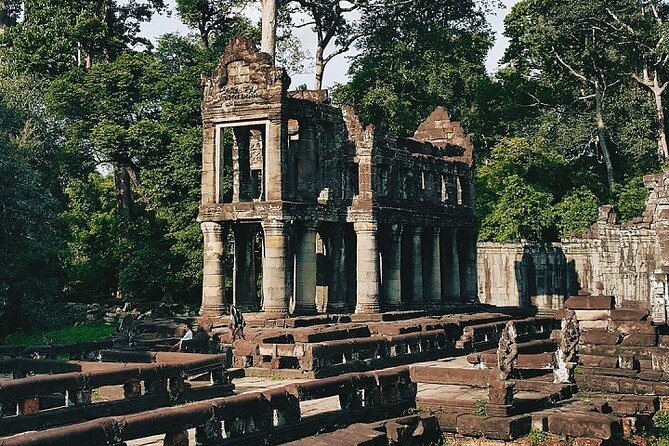
Finally, you visit Preah Khan, described as a vast 12th-century Buddhist temple complex with atmospheric corridors and intricate carvings. It also has a mix of Hindu and Buddhist influences and was originally built as a monastery and school.
If you like temples that feel like a whole complex rather than a single highlight, this is a strong closing stop. The corridors and mixed influences are exactly the kind of detail a good guide can translate into something you can feel, not just facts you forget.
After completing the day’s visits, you return to your hotel to relax.
Guides and drivers: English explanations plus steady, friendly handling
A big reason this tour gets high marks is how smoothly the day runs with human guidance. English-speaking guides are included, and the experience is often led by people like Choub, Sovuth Sun, and Mr Sok Chea. Drivers named in feedback include Mr Kosal and Ben, both described as on time, kind, and attentive, with cool towels and cold water repeatedly during the day.
You should expect a guide who can point out what you are looking at, connect temples to their purpose, and adjust when you want more time in one spot. That flexibility is one of the best parts of a private format.
If you care about explanations, ask questions while you are walking, not only at stops. You will get more out of the stone when you can tie what you see to what your guide says in the moment.
Dress code: plan for covered shoulders and knees, not last-minute fixes
Temple rules are strict enough that I recommend you treat clothing as part of the tour planning. You may use a scarf to cover your knees and shoulders for most temples. But there is an exception: for Angkor Wat, you must wear pants and skirts that cover the knees, and shirts that cover the shoulders.
Short skirts, shorts, tank tops, and other revealing clothing items are not permitted. If you show up with the wrong outfit, you can lose time and get frustrated fast, especially with early sunrise timing.
Who should book this Angkor Wat sunrise plus sunset tour
This is a strong choice if you want:
- Two full days of temples with enough time to look at carvings, not only sprint between points
- Sunrise at Angkor Wat plus sunset at Phnom Bakheng, so your trip has two big light-show moments
- A private guide who can help you understand what you are seeing in English
- Included comfort basics like cold water and towels
It may not be ideal if you:
- Are on a tight budget and do not want to add the entrance ticket cost on top of $135
- Hate early mornings, since Day 2 pickup is 5:00 AM
- Do not want to follow the dress code (especially for Angkor Wat)
Should you book this tour?
If you want the full Angkor experience with sunrise and sunset, and you like the idea of English guidance plus private pacing, I think this tour is a good bet. The route mixes big icons like Bayon and Angkor Wat with moodier stops like Ta Prohm and more detailed carving-focused temples like Banteay Srei.
Just do two things before you book: budget for the entrance ticket, and pack clothing that meets the temple rules. If you handle those, you are set up for two days that feel more like a guided story than a photo scavenger hunt.
FAQ
Is the Angkor Archaeological Park entrance ticket included in the tour price?
No. The entrance ticket is not included. The ticket is listed as USD 62 per person for 2 to 3 days and must be purchased separately.
What is the starting time for the Day 1 pickup?
Your guide meets you in your hotel lobby at 8:30 AM on Day 1.
What is the pickup time for the Day 2 sunrise?
On Day 2, your guide picks you up from your hotel at 5:00 AM for sunrise at Angkor Wat.
Are lunch and drinks included?
Lunch is not mentioned as included, even though there is a lunch stop during Day 1 at a nearby restaurant recommended by the guide.
What transport will I use on each day?
For 1 to 2 people, Day 1 uses a tuk-tuk and Day 2 uses a private car. For groups of 3 or more, you use an A/C van or bus for both days.
Does the tour include a guide, and what language do they speak?
Yes. The tour includes a professional English-speaking guide.
What is included during the tour for comfort?
The tour includes free cold water and towels during the tour.
Do I need an entrance ticket for children under 12?
Children under 12 can join free of charge and do not need to purchase an entrance ticket, but a passport must be shown as proof.
What is the dress code for the temples?
You may use a scarf to cover your knees and shoulders for most temples. For Angkor Wat, you must wear pants and skirts that cover the knees and shirts that cover the shoulders. Short skirts, shorts, and tank tops are not permitted.
Can I cancel and get a full refund?
Yes, you can cancel for free up to 24 hours in advance of the experience start time for a full refund. If you cancel less than 24 hours before, the amount paid will not be refunded.
More Tours in Siem Reap
- Angkor Wat Sunrise or Sunset Tour with Guide from Siem Reap★ 5.0 · 12,109 reviews
- Siem Reap: Angkor Wat: Small-Group Sunrise or Sunset Tour★ 5.0 · 9,444 reviews
- From Siem Reap: Kampong Phluk Floating Village Tour by Boat★ 4.9 · 6,979 reviews
- Siem Reap: Angkor Wat 2-Day Tour with Sunrise and Sunset★ 4.9 · 4,429 reviews
More Tour Reviews in Siem Reap
- Angkor Wat Sunrise or Sunset Tour with Guide from Siem Reap★ 5.0 · 12,109 reviews
- Siem Reap: Angkor Wat: Small-Group Sunrise or Sunset Tour★ 5.0 · 9,444 reviews
- From Siem Reap: Kampong Phluk Floating Village Tour by Boat★ 4.9 · 6,979 reviews
- Siem Reap: Angkor Wat 2-Day Tour with Sunrise and Sunset★ 4.9 · 4,429 reviews
Sunrise at Angkor, Three More Ways
- Angkor Wat Sunrise or Sunset Tour with Guide from Siem Reap★ 5.0 · 12,109 reviews
- Siem Reap: Angkor Wat: Small-Group Sunrise or Sunset Tour★ 5.0 · 9,444 reviews
- Siem Reap: Angkor Wat 2-Day Tour with Sunrise and Sunset★ 4.9 · 4,429 reviews
- Angkor Wat Sunrise tour with Small – Group and Guide tours★ 5.0 · 3,655 reviews
Newly written up around Siem Reap
- Waterfall & River of 1000 Siva Linga- Kulen Mountain Private Tour
★ 5.0 · 3 reviews - Private Transfer from Siem Reap to Sihanoukville
★ 4.5 · 3 reviews - Private Tour to Koh Ker and Beng Mealea
★ 5.0 · 3 reviews - Private Transfer: Siem Reap Angkor Internation Airport to Hotel
★ 5.0 · 3 reviews - Kulen National Park Ticket -Waterfall & 1000 Lingas
★ 5.0 · 3 reviews - Kulen Waterfall & Kbal Spean Tour
★ 5.0 · 3 reviews
Angkor Wat Sunrise Tours, side by side.
 ★ 5.0Angkor Wat Sunrise or Sunset Tour with Guide from Siem ReapFrom $1812,109 reviews
 ★ 5.0Angkor Wat: Small-Group Sunrise or Sunset TourFrom $159,444 reviews
 ★ 4.9Angkor Wat 2-Day Tour with Sunrise and SunsetFrom $344,429 reviews
 ★ 5.0Angkor Wat Sunrise tour with Small – Group and Guide toursFrom $143,655 reviews
 ★ 5.0Angkor Wat Highlights and Sunrise Guided Tour from Siem ReapFrom $233,213 reviews
 ★ 5.0Full-Day Angkor Wat Sunrise Private Tour with Guide from Siem ReapFrom $602,920 reviews
 ★ 5.0Angkor Wat Sunrise & 3 Main Temples with Breakfast – Small GroupFrom $152,857 reviews
 ★ 4.9Angkor Wat Sunrise and Full-Day Sightseeing TourFrom $142,828 reviews
Also appears in