
REVIEW · ANGKOR
Siem Reap Angkor Wat Sunrise Explore The Most Iconic Temples
The sunrise at Angkor feels almost unfairly beautiful. This 8-hour tour gets you to Angkor Wat early, then lines up the next temples in a smooth loop so you can see big variety without planning chaos. I also liked the photo stops baked into the schedule, so you are not sprinting between sites. One possible drawback: if your group is large, a single English guide may end up repeating logistics and juggling questions, which can slow the pace.
What really made the day work for me was the guide quality. When the group had Noun (you might get him), his explanations were clear and he pointed out where to take better shots at Angkor Wat, not just random viewpoints. If you want a day that feels organized but still readable, this kind of English-led structure is a big plus.
In This Review
- Key highlights worth waking up for
- How the 8-hour circuit feels, from pickup to drop-off
- Price and value: what $13 really covers
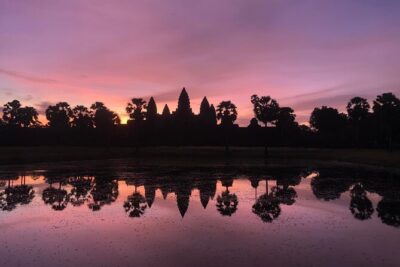
- The early start: sunrise at Angkor Wat the smart way
- What you’ll notice at sunrise
- Inside Angkor Wat: bas-reliefs, galleries, and the central sanctuary
- Why this guided portion helps
- Banteay Kdei: the calmer stop that makes the day feel balanced
- What to expect on this stop
- Ta Prohm: jungle temple mood and big root drama
- The upside and the trade
- Bayon Temple: 54 towers and faces that follow you
- How to get more out of Bayon
- Tonle Om Gate: the last photo stop before the ride back
- Why this final stop works
- Transportation, groups, and the guide factor
- Tips so your day runs smoother (without overthinking it)
- Who this tour fits best
- Should you book? My honest take
- FAQ
- FAQ
- What is the meeting area for pickup?
- What time does the tour start?
- What time will I be back in Siem Reap?
- How long is the experience?
- How much does the tour cost?
- Is transportation included, and is it air-conditioned?
- Is an English speaking guide included?
- Are temple ticket costs included?
- Is a meal included?
- Can I cancel for free, and can I pay later?
Key highlights worth waking up for
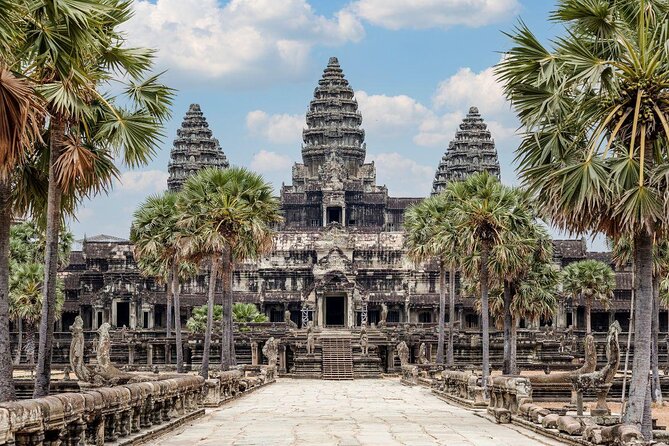
- Sunrise timing at Angkor Wat so you catch the towers over the moat before the main crush arrives
- Western entrance approach to angle into a quieter arrival at Angkor Wat
- A tight circuit of contrast temples from quiet corridors to heavy jungle atmosphere
- Ta Prohm’s tree roots over stone for that instantly recognizable, movie-famous look
- Bayon’s 54 towers and 200+ faces for a very specific kind of visual impact
- Tonle Om Gate photo pause with gods and demons lining the causeway
How the 8-hour circuit feels, from pickup to drop-off
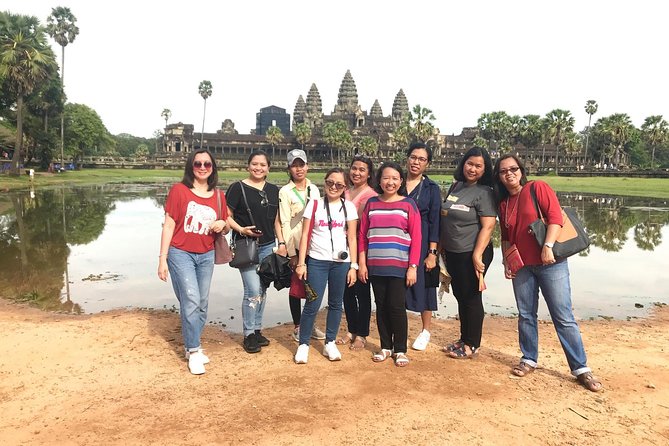
This is built as a full temple day, but it does not waste your time inside a van all day. You get pickup in Siem Reap City between 4:20am and 5:15am, you ride out in an air-conditioned minibus, and you are back by 12:00pm to 1:00pm. That means you finish early enough to still eat a proper lunch, rather than collapsing into evening plans.
The tour is also intentionally structured around photo moments. You have photo stops at each major site, then a guided walk through the main areas. It is a smart way to see the park without trying to self-drive a route while your energy is still waking up.
The headline value is that, for the set tour fee, you are paying for transport, an English-speaking guide, water, and pickup and drop-off. The temple ticket is not included, and there is no meal, so your day still needs a little self-planning for entry cost and food.
Price and value: what $13 really covers
At about $13 per person, the base cost is low, which is usually the goal for a tour like this. The trade-off is simple: temple tickets and your food are on you. In practical terms, you are getting a guided day across multiple sites with air-conditioned transport and a morning schedule that places you at Angkor Wat at sunrise.
If you are the type who wants maximum temple coverage without juggling tuk-tuk prices, entrance timing, and route logic, this is a strong value format. If you want a slower, private pace, or you hate group schedules, you may feel constrained.
Other ways to be at the temples before the light comes up
- Angkor Wat Sunrise or Sunset Tour with Guide from Siem Reap★ 5.0 · 12,109 reviews
- Siem Reap: Angkor Wat: Small-Group Sunrise or Sunset Tour★ 5.0 · 9,444 reviews
- Siem Reap: Angkor Wat 2-Day Tour with Sunrise and Sunset★ 4.9 · 4,429 reviews
- Angkor Wat Sunrise tour with Small – Group and Guide tours★ 5.0 · 3,655 reviews
The early start: sunrise at Angkor Wat the smart way
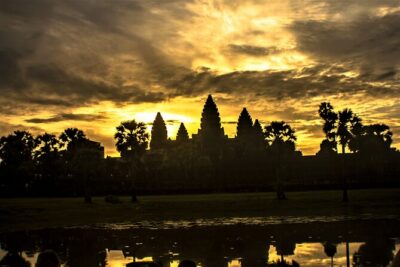
Angkor Wat at sunrise is not just a pretty backdrop. It is a completely different experience than arriving later. The air feels fresher, the light is softer, and the first impressions are all about scale, symmetry, and that reflective moat look.
This tour takes you to Angkor Wat at dawn and specifically routes you through the western entrance. That matters because it sets up your arrival with fewer people around at the moment you really want to see the composition. You get time for photos before the main crowds. If you care about getting your own angles, that early window is the difference between a fast snapshot and a calmer, more intentional walk.
What you’ll notice at sunrise
- The towers and galleries look sharper as light slides across the stone
- The moat reflection gives you framing options for photos
- You can actually slow down and take in details before the noise builds
The day moves quickly after sunrise, so treat this moment like the anchor. Once you are done here, you can enjoy the variety of the other temples without worrying that you missed the best light.
Inside Angkor Wat: bas-reliefs, galleries, and the central sanctuary
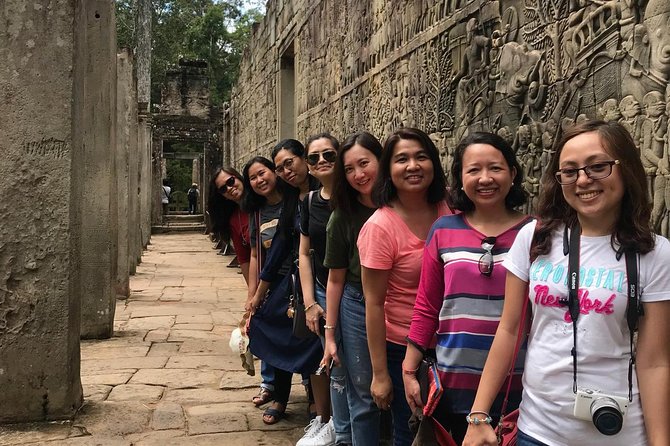
After the sunrise photo window, you explore inside Angkor Wat with a guided visit. You are not just looking at the exterior from one spot. You get to walk through key areas and understand what you are seeing.
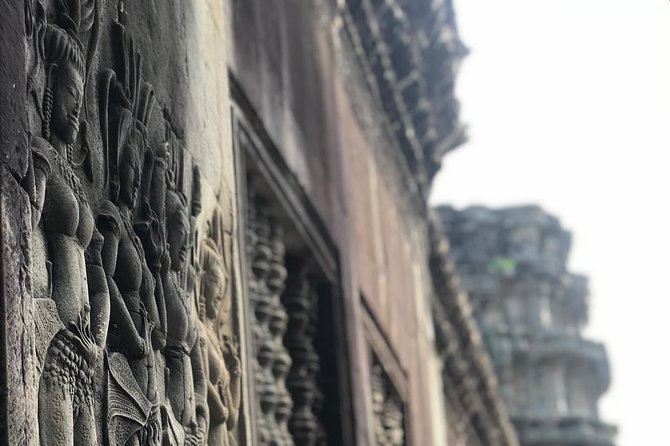
The temple began as a Hindu site dedicated to Vishnu, then later shifted to Buddhist use. That transition shows up in how the sacred spaces are organized and how the iconography feels when you are walking through the galleries and sanctuaries. Your guide points out the intricate bas-reliefs and the layered walkways that connect the main ceremonial areas.
Why this guided portion helps
If you visit without context, Angkor Wat can feel like a lot of stone that blurs together. With a guide, you get ways to break it into parts: carvings to look for, where to stand to read the galleries, and what to focus on so you leave knowing what you actually saw.
You do have to move at a group pace, but the trade is you get meaning, not just photos.
Other early starts around Siem Reap
Banteay Kdei: the calmer stop that makes the day feel balanced
After the big star of the morning, you go to Banteay Kdei, meaning Citadel of Chambers. This is one of those temples that feels more peaceful because it is often less crowded than the headline sites around it.
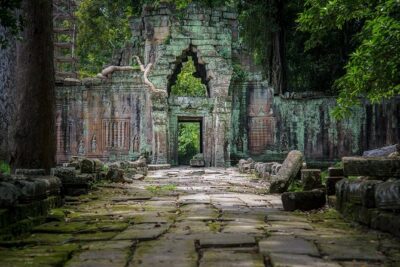
This monastery-style temple dates to the late 12th century and has serene corridors and carved details. It is also partly in ruins, and that matters. The damage is not a problem here, it creates atmosphere. You feel like you are walking through a place that is still being reclaimed by time.
What to expect on this stop
- A quieter walk compared to the busier, more famous sites
- Time to slow down and look at carvings and corridors
- A “mysterious” vibe that breaks up the energy of the day
If Angkor Wat and Ta Prohm feel like visual overload, Banteay Kdei is the relief stop that keeps you from burning out.
Ta Prohm: jungle temple mood and big root drama
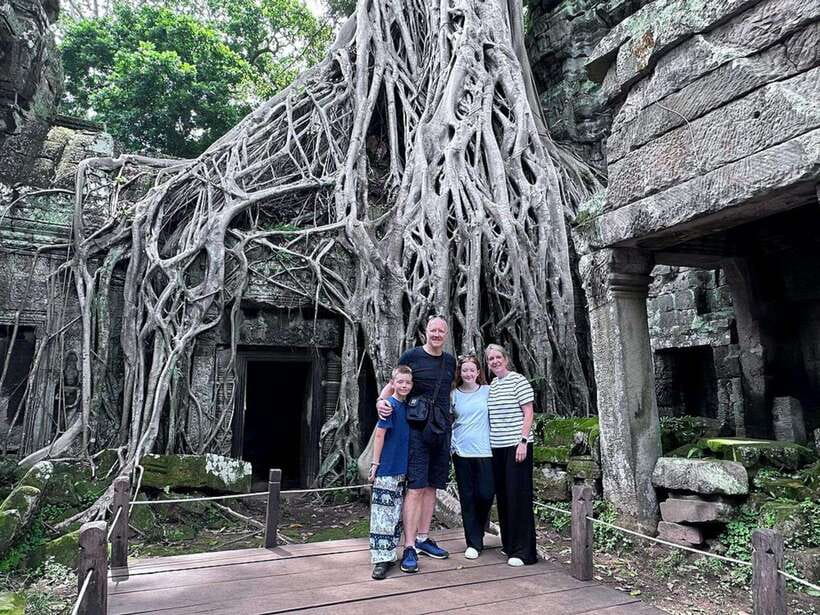
Then comes Ta Prohm, the temple that is instantly recognizable for the giant tree roots growing over the ruins. This is one of the most photogenic places in the whole park, and it is famous for a reason.
Ta Prohm was a 12th-century temple that was left largely unrestored, creating that jungle temple look. It also became world-famous thanks to the movie Tomb Raider with Angelina Jolie, so even first-time visitors often already know what they are about to see.
The upside and the trade
Ta Prohm is a great stop if you want something different from clean geometry. The roots and stone create natural frames for photos and give you that half-forgotten feeling.
The trade is that it can feel busy because it is so iconic. The guided loop and the walk time are designed to keep you moving, so you might not get a super long, slow wander in every exact corner. Still, it is hard to regret choosing this as part of your core circuit.
Bayon Temple: 54 towers and faces that follow you
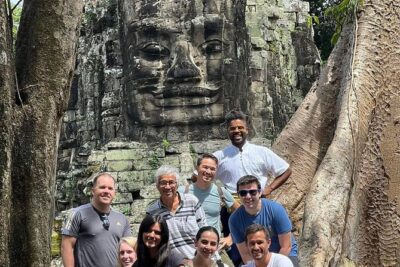
From Ta Prohm, you head to Bayon Temple at the center of Angkor Thom. Bayon is known for its 54 towers, each decorated with large stone faces of Avalokiteshvara. People often describe the faces as smiling, but what you really feel when you walk through is the sense of being watched, calmly, from multiple angles.
Bayon also has detailed carvings showing scenes of daily life and historical battles. So while Ta Prohm gives you the visual theater of jungle roots, Bayon gives you storytelling in stone.
How to get more out of Bayon
You’ll see the faces from several approaches. Your guide’s job is to help you notice how the carvings and tower placements relate. If you treat Bayon like just a photo backdrop, you miss the payoff. If you let the guide point out what to look for, Bayon becomes one of the most memorable parts of the day.
Tonle Om Gate: the last photo stop before the ride back
Near the end, you visit Tonle Om Gate, the southern gate of Angkor Thom. This is a dramatic entrance with a causeway lined with statues of gods and demons. The gate itself is crowned with four giant stone faces, similar in theme to what you see at Bayon.
Tonle Om is not about spending an hour reading carvings. It is about atmosphere and composition. The statues along the causeway give you strong leading lines for photos, and the gate gives you a clear end-of-circuit landmark.
Why this final stop works
By the time you reach Tonle Om Gate, you have already seen multiple temple styles and multiple scales. This gate acts like a visual punctuation mark. It helps the day feel complete, then you transition back to your minibus with less mental scrambling.
Transportation, groups, and the guide factor
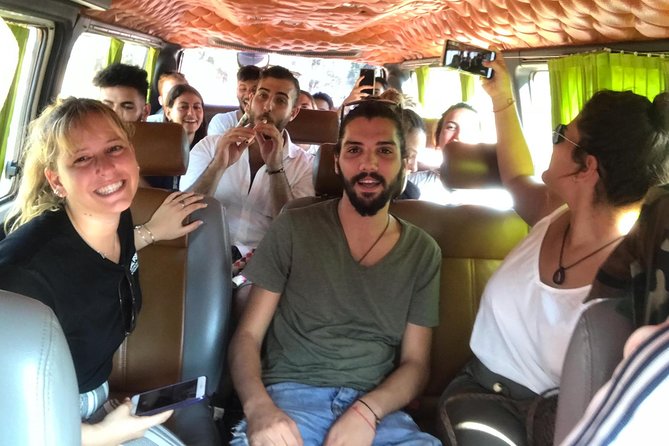
Transport is included, and it is air-conditioned, which matters because mornings start cool but you can still feel heat and dust building later. You also get drinking water during the tour, which helps you avoid the uncomfortable moment of realizing you are running low before lunch.
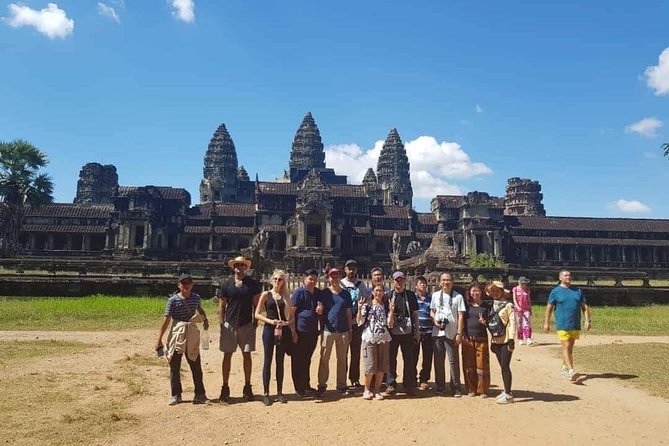
The group setup can be the biggest variable day to day. One issue that can happen is a large group with only one guide to manage everyone. When that happens, you may feel like you are hearing repeated information and waiting for the guide to confirm everyone is still on the route. The good news is that the guide and driver can still be friendly and helpful, but group size affects pace and attention.
On the positive side, the English speaking format is a real advantage. If your guide is strong, you get more than directions. You get ways to look at the carvings, understand the layout, and choose better photo positions.
Tips so your day runs smoother (without overthinking it)
You are leaving very early, so treat the morning like a mission. Here are practical ways to make the experience better based on how the day is built:
- Plan around no meal included. Eat before pickup or be ready to grab food soon after you return.
- Expect a few walks across different temples, including longer walking stretches at the major stops.
- Bring patience for a group schedule. The best approach is to focus your energy on what you want most, sunrise and faces, for example, then enjoy the rest as bonus variety.
- If photos are important, use the provided photo stops as your cue to slow down and actually frame shots.
Who this tour fits best
This tour works especially well if:
- You want a guided sunrise Angkor Wat morning and you do not want to figure logistics on your own
- You like seeing multiple temple styles in one day, from calm to jungle to monumental gateways
- You prefer an English guide who can explain what you are looking at and suggest where to stand
It might not be your best fit if:
- You hate group pacing and want lots of quiet time without waiting
- You want meals included or a more relaxed, linger-at-each-stop rhythm
Should you book? My honest take
I would book this if you want an efficient, classic Angkor circuit with a real sunrise payoff. The combination of early Angkor Wat, a quieter temple like Banteay Kdei, the movie-famous chaos of Ta Prohm, the faces of Bayon, and the gateway drama of Tonle Om Gate gives you a well-rounded day in about 8 hours.
The biggest reason to hesitate is the group dynamic. If your comfort level is low for waiting and repeated explanations, you might want a smaller-group alternative. But if you are okay sharing the day with others and you care most about seeing these iconic sites in one organized run, this is a smart pick.
FAQ
FAQ
What is the meeting area for pickup?
Pickup is included from your hotel in Siem Reap City, and the activity notes pickup between 4:20am and 5:15am.
What time does the tour start?
The pickup window is between 4:20am and 5:15am.
What time will I be back in Siem Reap?
The tour ends between 12:00pm and 1:00pm.
How long is the experience?
The duration is 8 hours.
How much does the tour cost?
The price is listed as $13 per person.
Is transportation included, and is it air-conditioned?
Yes. Transportation is included, and it is described as an air-conditioned bus or minibus.
Is an English speaking guide included?
Yes, the tour includes an English speaking live guide.
Are temple ticket costs included?
No, temple tickets are not included.
Is a meal included?
No, meals are not included.
Can I cancel for free, and can I pay later?
Free cancellation is available up to 24 hours in advance for a full refund. There is also a reserve now & pay later option described as pay nothing today.
Other Pre-Dawn Departures
- Angkor Wat Sunrise or Sunset Tour with Guide from Siem Reap★ 5.0 · 12,109 reviews
- Siem Reap: Angkor Wat: Small-Group Sunrise or Sunset Tour★ 5.0 · 9,444 reviews
- Siem Reap: Angkor Wat 2-Day Tour with Sunrise and Sunset★ 4.9 · 4,429 reviews
- Angkor Wat Sunrise tour with Small – Group and Guide tours★ 5.0 · 3,655 reviews
More Tour Reviews in Siem Reap
- Angkor Wat Sunrise or Sunset Tour with Guide from Siem Reap★ 5.0 · 12,109 reviews
- Siem Reap: Angkor Wat: Small-Group Sunrise or Sunset Tour★ 5.0 · 9,444 reviews
- From Siem Reap: Kampong Phluk Floating Village Tour by Boat★ 4.9 · 6,979 reviews
- Siem Reap: Angkor Wat 2-Day Tour with Sunrise and Sunset★ 4.9 · 4,429 reviews
Sunrise at Angkor, Three More Ways
- Angkor Wat Sunrise or Sunset Tour with Guide from Siem Reap★ 5.0 · 12,109 reviews
- Siem Reap: Angkor Wat: Small-Group Sunrise or Sunset Tour★ 5.0 · 9,444 reviews
- Siem Reap: Angkor Wat 2-Day Tour with Sunrise and Sunset★ 4.9 · 4,429 reviews
- Angkor Wat Sunrise tour with Small – Group and Guide tours★ 5.0 · 3,655 reviews
Newly written up around Siem Reap
- Waterfall & River of 1000 Siva Linga- Kulen Mountain Private Tour
★ 5.0 · 3 reviews - Private Transfer from Siem Reap to Sihanoukville
★ 4.5 · 3 reviews - Private Tour to Koh Ker and Beng Mealea
★ 5.0 · 3 reviews - Private Transfer: Siem Reap Angkor Internation Airport to Hotel
★ 5.0 · 3 reviews - Kulen National Park Ticket -Waterfall & 1000 Lingas
★ 5.0 · 3 reviews - Kulen Waterfall & Kbal Spean Tour
★ 5.0 · 3 reviews
Angkor Wat Sunrise Tours, side by side.
 ★ 5.0Angkor Wat Sunrise or Sunset Tour with Guide from Siem ReapFrom $1812,109 reviews
 ★ 5.0Angkor Wat: Small-Group Sunrise or Sunset TourFrom $159,444 reviews
 ★ 4.9Angkor Wat 2-Day Tour with Sunrise and SunsetFrom $344,429 reviews
 ★ 5.0Angkor Wat Sunrise tour with Small – Group and Guide toursFrom $143,655 reviews
 ★ 5.0Angkor Wat Highlights and Sunrise Guided Tour from Siem ReapFrom $233,213 reviews
 ★ 5.0Full-Day Angkor Wat Sunrise Private Tour with Guide from Siem ReapFrom $602,920 reviews
 ★ 5.0Angkor Wat Sunrise & 3 Main Temples with Breakfast – Small GroupFrom $152,857 reviews
 ★ 4.9Angkor Wat Sunrise and Full-Day Sightseeing TourFrom $142,828 reviews
Also appears in